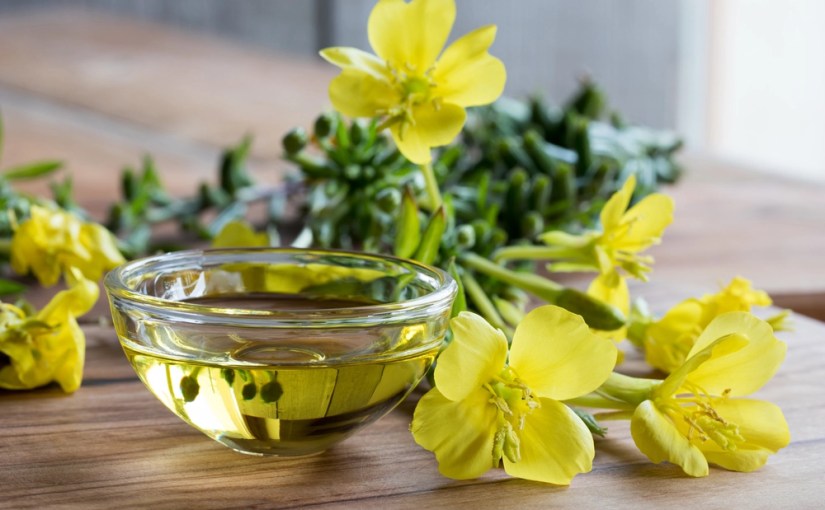
Evening primrose is a plant that is commonly found growing in locations across Europe and North America. It has been used for various medicinal purposes for a long time, with the Native Americans utilising the leaves, roots and seed pods to make remedies for wounds, bruises and skin issues.
Keep reading to find out all about evening primrose oil, including what it does and the benefits of taking it.
What Does Evening Primrose Oil Do?
Evening Primrose Oil (EPO) is widely used as a dietary supplement owing to its high concentration of Gamma-Linolenic Acid (GLA), a type of fatty acid known as omega-6. Additionally, EPO is a rich source of vitamin E. The vitamin and fatty acid content in EPO is not abundantly available from other natural food sources, therefore supplemental use is recommended in the conditions discussed in this article.
This supplemental oil is popular among:
⁃ Those experiencing menstrual discomfort
⁃ Menopausal women
⁃ Those seeking to maintain healthy skin
The fatty acids in Evening Primrose Oil (EPO) are utilised by the body to make a hormone-like substance, which plays a vital role in regulating the health of many systems in the body, including the nervous system, cardiovascular system and the reproductive system, as well as promoting healthy skin and other functions.
Although Linoleic Acid present in vegetable oils can be converted into GLA by the body, this process can be slow and inefficient, so taking supplemental sources of GLA may be highly beneficial for some people.
Researchers have established the effectiveness of GLA supplements in illnesses, such as those related to female reproductive health and skin complaints.
Read on to find out how introducing evening primrose oil to your routine could benefit you.
Women’s Health:
Common health issues in women include acne, Premenstrual Syndrome (PMS), and menopause. These conditions are often due to hormonal imbalances. It is suggested by holistic health practitioners that evening primrose oil may help alleviate some of these conditions. However, the holistic health approach in general does not advocate for ‘quick fix’ supplemental use. Instead, the body is viewed as a whole and therefore the holistic approach aims to identify and address the root cause of any health issue. That said, evening primrose oil may assist in the natural healing process and may be worth adapting into your routine if you suffer from the conditions listed in this article. If you are unsure of how to use the supplement, or what dose will be correct for you, please consult with a holistic health practitioner, or enquire in your local health food store or natural health store.
Healthy Cycles:
Clinical studies have primarily focused on breast pain associated with PMS in relation to menstrual discomfort. Women have reported relief from PMS symptoms with the consumption of evening primrose oil, including breast tenderness, depression, irritability, swelling and bloating caused by fluid retention.
GLA, when present in the body, can disrupt the creation of inflammatory particles. This can provide some alleviation of menstrual cramps, along with symptoms such as bloating, headaches, and breast tenderness.
Menopause:
The use of evening primrose oil has been found to be effective in reducing hot flashes in women who are premenopausal or experiencing menopause. It is believed that this effect is due to the oil’s action as an oestrogen agonist. An oestrogen agonist is a substance that triggers the actions of oestrogen receptors in cells, leading to effects similar to those of oestrogen.
Healthy Skin:
EPO has been associated with improved skin health. The GLA in EPO is thought to enhance the skin’s outermost layer, or epidermis, thereby improving skin barrier function. This may explain why EPO is commonly used to alleviate skin conditions like eczema, dermatitis, and acne, as well as dryness caused by dehydration. Moreover, EPO’s potential regulatory effects on female reproductive hormones may also benefit hormonal skin. Studies have indicated that taking GLA supplements can reduce acne.
In Summary:
Evening primrose oil is a valuable source of omega-6 essential fatty acids, including linoleic acid and GLA, which may aid in relieving symptoms associated with PMS and menopause, as well as improving certain skin conditions.
Interactions:
If you are concerned about its interactions with medications, please consult with your doctor prior to using evening primrose oil supplements.
Sensible Car Finance is a broker service offering advice on the best car finance package for you.
Sources used:
Horrobin DF. The role of essential fatty acids and prostaglandins in the premenstrual syndrome. J Reprod Med. 1983 Jul;28(7):465-8.
Mahboubi M. Evening Primrose (Oenothera biennis) Oil in Management of Female Ailments. J Menopausal Med. 2019 Aug;25(2):74-82.
van der Sluijs CP, Bensoussan A, Liyanage L, Shah S. Women’s health during mid-life survey: the use of complementary and alternative medicine by symptomatic women transitioning through menopause in Sydney. Menopause. 2007 May-Jun;14(3 Pt 1):397-403.
Farzaneh F, Fatehi S, Sohrabi MR, Alizadeh K. The effect of oral evening primrose oil on menopausal hot flashes: a randomized clinical trial. Arch Gynecol Obstet. 2013;288:1075–1079.
Schäfer, L. and Kragballe, K. (1991), Supplementation with evening primrose oil in atopic dermatitis: Effect on fatty acids in neutrophils and epidermis. Lipids, 26: 557-560.
Jung, J.Y., Kwon, H.H., Hong, J.S., Yoon, J.Y., Park, M.S., Jang, M.Y., & Suh, D.H. (2014). Effect of Dietary Supplementation with Omega-3 Fatty Acid and Gamma-linolenic Acid on Acne Vulgaris: A Randomised, Double-blind, Controlled Trial. Department of Dermatology, Seoul National University
Jamal, G.A. and Carmichael, H. (1990), The Effect of γ-Linolenic Acid on Human Diabetic Peripheral Neuropathy: A Double-blind Placebo-controlled Trial. Diabetic Medicine, 7: 319-323.












 USA Today Health Blog